 AMPROTEQ
HELIOSH250 · H500
250 – 500 kW · PV straight into the battery · indoor IP21 or outdoor IP55

Solar into the battery,
not through the grid.
HELIOS takes PV strings straight onto the DC bus of an AMPROTEQ battery. Each string gets its own 50 kW DC/DC channel with its own MPPT, and the cabinet charges the battery through one breaker. There is no PV inverter in between, so solar is stored in one conversion, and the battery's PCS delivers it when the site needs it.
Up to 160 A per channel. Open-circuit voltage kept 20 V under the battery.
MPPT on the PV side, boost to the battery bus. Five per H250, ten per H500.
The channels share one bus, which reaches the battery through one breaker, QF1.
A1000 · A2000, 728–936 V. HELIOS reads the BMS over CAN.
One converter.
Two enclosures.
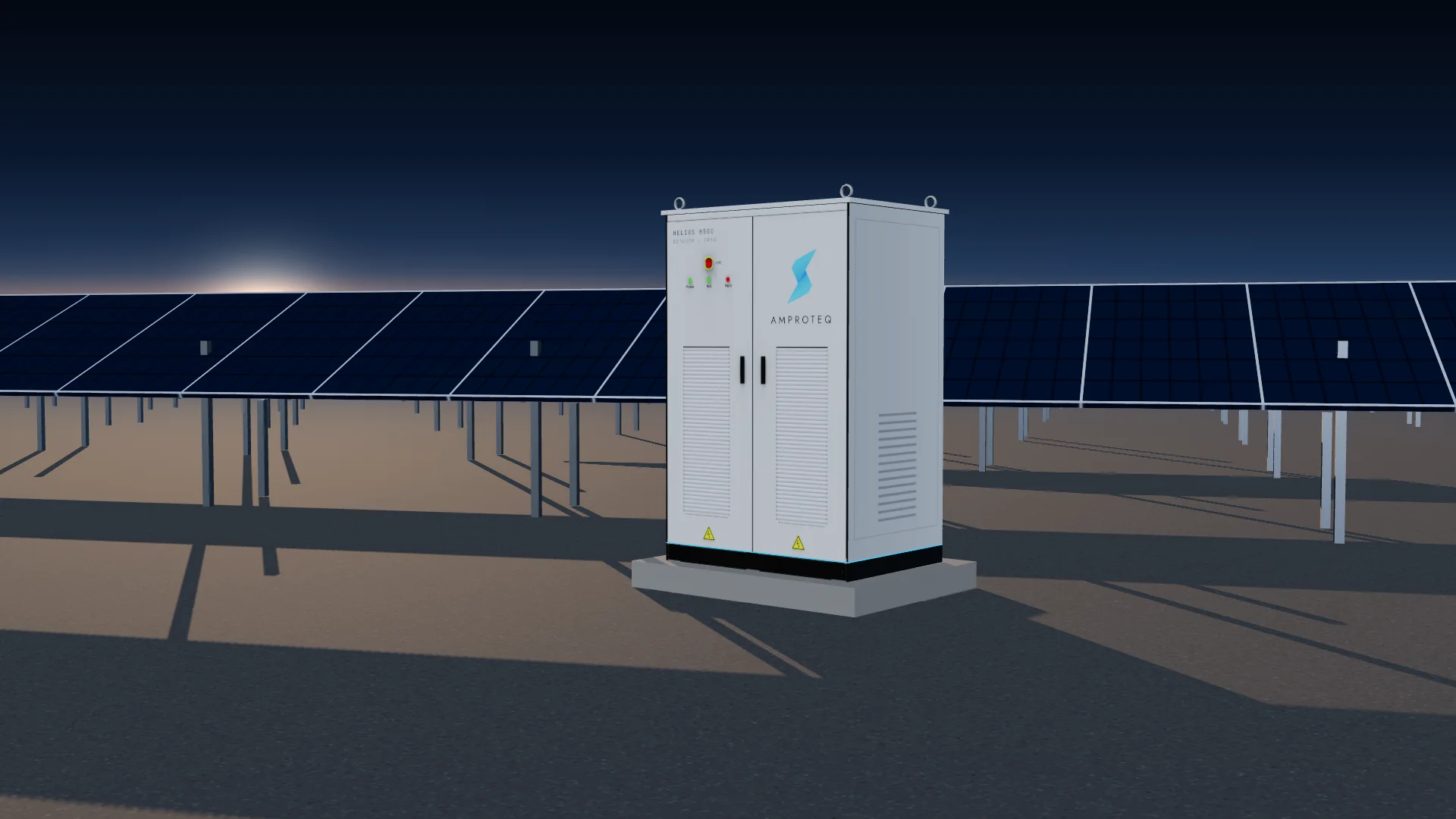
Each rating comes as an indoor cabinet for a plant room and an outdoor cabinet for the yard. The channels, breakers and control inside are the same, and so are the electrical ratings.
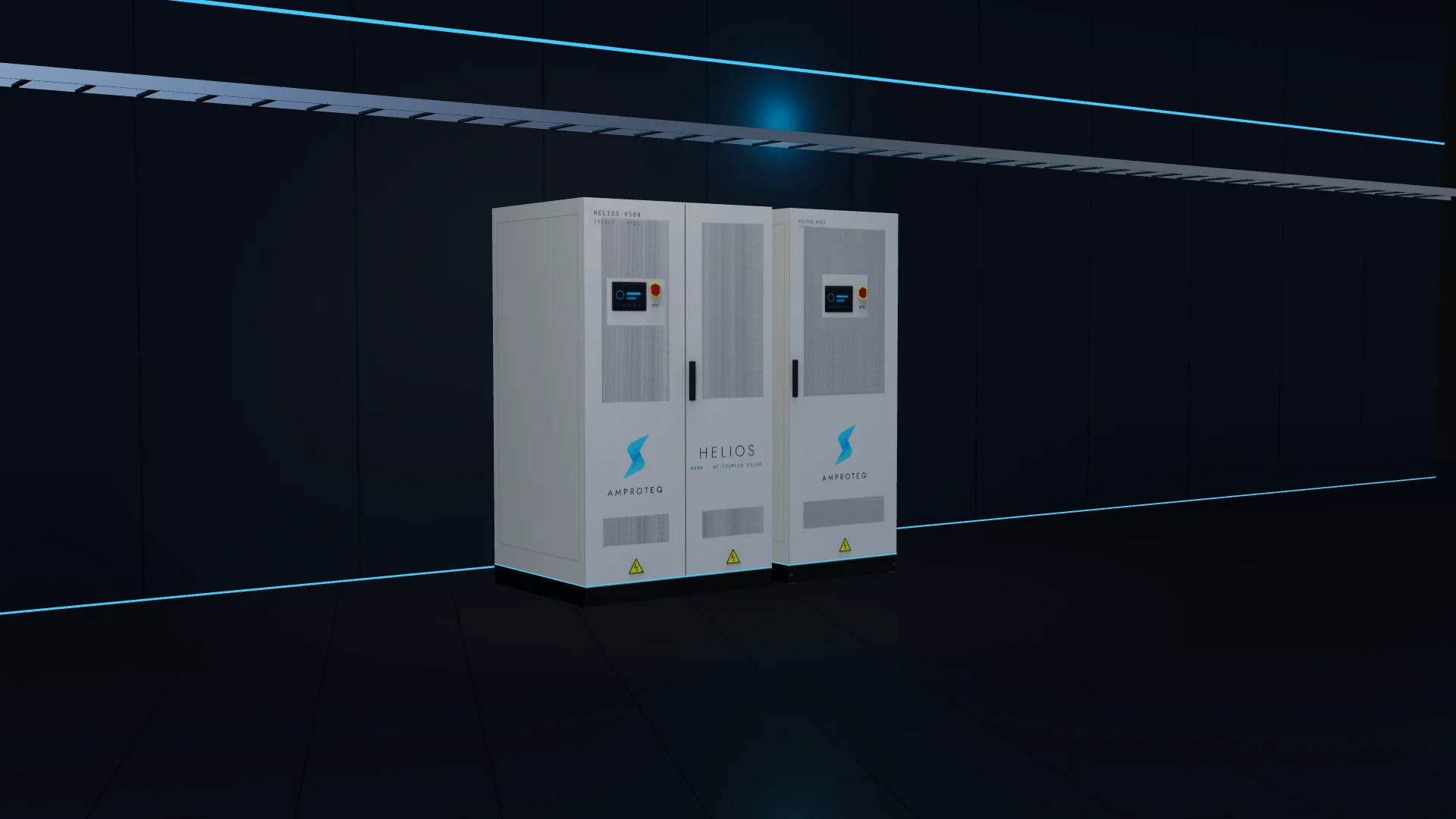
For a plant room, switch room or container.
- Models
- H250-I · H500-I
- On the door
- Touch LCD panel and EPO
- Air path
- Perforated doors, lower grilles
- W × D, mm
- 800 × 800 · 1 200 × 1 000
- Weight
- ≈ 450 · 750 kg
For the yard, a roof or a plinth beside the array.
- Models
- H250-O · H500-O
- On the door
- EPO, Power · Run · Fault lamps
- Air path
- Louvred, rain-shielded intakes
- W × D, mm
- 900 × 1 000 · 1 350 × 1 000
- Weight
- ≈ 660 · 900 kg
Two ratings,
each indoors or out.
The 500 kW cabinets take ten channels behind a two-door front. Outdoor cabinets add lifting eyes, louvred intakes and lamps you can read from the yard.

- Local control panelTouch LCD · monitor · upgrade
- Perforated doorsIndoor air path · IP21
- Lifting eyesFour points · crane set-down
- EPO & status lampsPower · Run · Fault
- Front-access doorsLockable · rack modules
- Air coolingIntelligent, fan-controlled
- Louvred intakeRain-shielded · IP55
- Two-door frontFull-width module access
Count the conversions.
AC-coupled solar is inverted to AC and converted back to DC before it is stored. HELIOS stores it in one DC/DC step, so a tight export limit never curtails the array: solar the connection cannot take goes into the battery.
Solar via the AC bus
Solar on the battery bus
In both, the battery delivers through its PCS, DC → AC, when the site needs it.
Charged by the sun.
Spent on the peak.
An H500 charging an A2000 (2 MWh) through a clear day. Drag across the chart, or use the slider, to read any moment.
- PV available
- 0 kW
- Into the battery via HELIOS
- 0 kW
- Battery full: site or curtailed
- 0 kW
- Battery to site via PCS
- 0 kW
- State of charge
- 0 %
Illustrative, not a yield forecast. 260 kW PV peak, 280 kW evening discharge, 95 % charge cap. Solaris™ sets the limits on your site.
Five design decisions.
- 01
Solar straight to storage
One DC/DC stage from the PV string to the battery bus. No PV inverter in between.
- 02
Behind any export cap
PV charges the battery on the DC side, so a tight export limit does not curtail the array.
- 03
Its own MPPT per channel
Five or ten 160 A channels. Roofs facing different ways each track their own peak.
- 04
Indoor or outdoor
IP21 for a plant room, IP55 for the yard. Same converter, same rating.
- 05
Sold as a system
Supplied only with an AMPROTEQ battery and Solaris™ EMS, commissioned as one.
Three sites it is designed for.
- 01
Export-capped sites
Solar the connection cannot take goes into the battery instead of being curtailed, and is spent on the next peak.
- 02
Solar onto storage
Add an array to an AMPROTEQ battery without a second AC connection or a new PV inverter station.
- 03
Islanded running
HELIOS works on the DC bus, so PV keeps charging the battery while the site runs off-grid through an outage.
PV stays under the battery.
Each channel boosts PV up to the battery, so a string's cold open-circuit voltage must stay 20 V under the battery's lowest voltage. On an A1000 or A2000, that leaves strings up to 708 V.
Sold as a system,
never on its own.
HELIOS, the battery and the controller are sized, delivered and commissioned together, so the voltages, limits and dispatch are matched from day one. HELIOS pairs with the A1000 and A2000, whose 728–936 V string sits inside its battery window. The 1 500 V DC blocks, A3000 to A6250, are outside it.
Up to 708 V Voc, 5 or 10 channels per cabinet.
DC/DC with MPPT per channel, onto the battery bus.
1–2 MWh LFP, 728–936 V, with its PCS inside.
AC from the battery's PCS, inside your export limit.
One AMPROTEQ supply · HELIOS is not sold separately
Match the solar
to the battery.
One H250 or H500 per A1000; one or two H500 per A2000. The pairing sets how hard the sun charges the battery: a quarter or half of its capacity per hour at full PV. The battery's BMS limit sets the final charge current.
A2000 · 2 MWh · PCS 500 kW or 1 MW
Calculated at rated power and 832 V, losses ignored. Battery figures per the A1000 and A2000 datasheets.
HELIOS · H250 and H500
Typical configuration. Where two values are given, they are H250 · H500. Final values are fixed in the project technical agreement.
- PV port
- PV voltage range
- 250 V … battery minimum − 20 VOpen-circuit voltage stays below the battery
- MPPT channels
- 5 · 10
- Max. PV input current
- 5 × 160 A · 10 × 160 A
- Power per channel
- ≈ 50 kW, full power from ≈ 313 VCalculated: bus power ÷ channels, ÷ 160 A
- Channel protection
- QF2–QF6 · QF2–QF11
- Surge protection
- SPD on the PV side and the battery side
- Battery port
- Battery voltage range
- 600 – 950 VA1000 · A2000: 728–936 V
- DC bus power
- 250 kW · 500 kW
- DC inputs
- 1
- Battery current, max.
- ≈ 417 A · ≈ 833 ACalculated at 600 V
- Battery protection
- QF1 DC breaker · SPD1
- Control & system
- Supplied with
- AMPROTEQ APEX A1000 / A2000 + Solaris™ EMSNot sold as a stand-alone converter
- Local panel
- LCD: monitoring, strategy set-up, remote upgrade
- BMS communication
- CAN
- EMS communication
- RS-485 / CAN / Ethernet
- MPPT controller
- Configured per project
- Enclosure
- Protection
- IP21 indoor (-I) · IP55 outdoor (-O)
- Protective class
- I
- Indoor, W × D
- 800 × 800 · 1 200 × 1 000 mm
- Outdoor, W × D
- 900 × 1 000 · 1 350 × 1 000 mm
- Height
- 2 100 mm, all cabinets
- Weight, indoor
- ≈ 450 · ≈ 750 kg
- Weight, outdoor
- ≈ 660 · ≈ 900 kg
- Construction
- Modular rack, front maintenance; single- or double-row layouts
- Environment
- Ambient temperature
- −25 … +60 °C, derating above 45 °C
- Relative humidity
- 0 – 95 %, non-condensing
- Altitude
- 3 000 m, derating above
- Cooling
- Intelligent forced air
- Noise
- < 78 dB
- DC/DC module · tested to
- Safety
- EN 62109Power converters in PV systems
- EMC
- EN IEC 61000
- Applies to
- The DC/DC module; system tests per project
H500–OModel code. HELIOS series · kW, 250 or 500 · O outdoor, I indoorScope of supply: DC/DC modules on a rack, PV channel breakers, battery breaker, surge protection, the local control panel and the EMS interface, factory-integrated and tested before dispatch. Supplied only within an AMPROTEQ system with an A1000 or A2000 battery and Solaris™ EMS. PV array and DC cabling are scoped per project. Currents marked ≈ are calculated at rated power.
From roof plan to charging.
- 01
Array & site
PV layout, module datasheet, export limit and twelve months of interval data.
- 02
System design
String plan per channel, HELIOS and battery sizing, single-line diagram and the yield case.
- 03
Delivery
HELIOS and the battery, factory-integrated and tested before dispatch, indoors or on prepared plinths.
- 04
Energise
String and battery terminations, commissioning, then Solaris™ EMS takes over dispatch.
- PV layout and module datasheet
- Export limit or grid agreement
- 12 months of 30-minute interval data
- Indoor plant room or outdoor yard
- The dispatch you need: hours, peaks, backup
- String plan inside the PV window
- HELIOS, battery and PCS sizing
- Single-line diagram and general arrangement
- Yield and dispatch model on your load data
- Offer with warranty terms